

Become a Member!
Become a Six Colors member to read exclusive posts, get our weekly podcast and regular newsletters, and much more!by Jason Snell
HomeView is simple, and that’s a good thing
The best writer on the smart home beat today is The Verge’s Jennifer Pattison Tuohy, who I think has the best take on the HomeView I’ve seen so far:
HomeView’s simplicity may put off hardcore home automation enthusiasts, but I’d argue it’s perfect for their long-suffering spouses. I’ve tried every version of physical smart home control interface in my home, and you know who hasn’t used any of them? My family.
Because my family all have iPhones, and because the HomeView will always be there and will feel familiar, I can see them actually using it. That means I could set up a full Home Assistant instance and run a detailed dashboard on a tablet in my office, then feed the scenes and devices into Apple Home so my husband and daughter can just tap to control them on a HomeView in the kitchen.
HomeView may not be the smart home computer I want Apple to make, but it is the smart home device Apple needed to make.
My own thermostat, which came with my HVAC system, is a piece of junk, and I can’t replace it because it is incompatible with third-party thermostats. But I can envision putting a HomeView on the wall and making that the primary interface for it and every other smart home device in my house.
Our thoughts on the new HomeView and its confusing pricing, whether we’re using AI agents like Meta’s Muse or OpenAI’s Dots, how we feel about passkeys, and if we’d ever use an Apple Pencil with an iPhone Fold.
By Glenn Fleishman
Share your location in Messages, now for a custom period

Apple stuffs a lot of different kinds of tasks into Messages. It’s a junk drawer for communications with other people. Send photos? Sure. Set up a safety partner for when you are going somewhere? Why not. Pay somebody? Of course! And, yeah, let’s stick in a poll!
But I think the best use beyond text and media of Messages is sharing your location. It’s a convenient way to share your whereabouts with someone else or a group, either indefinitely or for a fixed time period. Starting in the version 27 operating systems, you don’t have to use Apple’s preset periods, either: you can set a custom duration, which can be up to 30 days.
Sharing your location in Messages is an extension of Apple’s Find My service and native apps. You can also share your location within a native Find My app—that’s on an iPhone, iPad, Mac, or Apple Watch, not iCloud.com’s Find My, which only works with devices.

Like everything with Find My, your current location is locked down except to share with those you explicitly permit, and only for the period you choose, or indefinitely.
Continue reading “Share your location in Messages, now for a custom period”…
by Dan Moren
New Siri Remote’s Find My feature limited to N1-equipped iPhones
I was curious about the limitations of the new Siri Remote‘s Precision Finding feature, which requires an iPhone 17 generation or newer. Earlier iPhones have Apple’s latest U-series ultra wideband chip, which is what Find My generally uses, so why wouldn’t they be compatible?
Stevie Bonifield at The Verge has the answer:
Now the remote has Find My support, but if you want to see exactly how far away it is on your iPhone with details like “20 feet,” rather than simply “far” or “near,” you will need to have an iPhone Duo, iPhone Air, or any iPhone 17 or later. Those are the only models that include its new N1 networking chip with support for Bluetooth channel sounding, which enables AirTag-like precision tracking, but without requiring a UWB chip.
So before you run out and buy a new $59 remote and then hand it over to your pet to lose, make sure you’ve got a compatible phone I guess.
Two decades after the Walkman had revolutionized personal audio, a new compressed digital audio format emerged that would redefine how we listen to music. We kick off our series about the origin of Apple’s hit MP3 player, the iPod.
This week we talk about Apple’s new devices and absolutely no Apple blogger drama whatsoever.
By Jason Snell
Third-party HomeView apps? Think CarPlay

Apple’s new HomeView device doesn’t have an App Store, but it does have an app story, of a sort. There are some selected Apple apps on its (surprisingly) iPad-like home screen, but you can’t add more. What’s a person to do?
If you use apps that play audio or video and support CarPlay, though, you’re in luck: HomeView supports those apps, and just those apps, via projection from your iPhone. So if you’re a fan of Overcast or Spotify, you’re in luck.
And if you’re curious about video CarPlay, well, that’s a feature Apple added this year that lets apps play video using CarPlay when the car is parked. And the HomeView is always parked.
Beyond that, though, it seems like HomeView is at least starting life as a very limited app platform. Apple does say that if you make a Siri AI query for your personal content, it will search everything on your iPhone or iPad—and that includes apps that aren’t on the HomeView. So you should be able to query your iPhone apps, but not actually run them.
In the short term, this means that if you want to (for example) access your calendar right on your device, you will probably have to do so via Apple’s Calendar app, even if you use a different app on your other devices. (If you use an app that has a web app equivalent, you could probably open it up in Safari, which is an app that the HomeView does offer.)
In the long term, I still think it’s quite likely that Apple will eventually expand what can be run on HomeView. I haven’t used one yet, but based on what I’ve seen on Apple’s website, it feels very much like a 1.0 product with plenty of room for expansion. Whether that comes in the form of apps, widgets, or access for CarPlay apps that aren’t audio or video apps, remains to be seen.
We break down Apple’s big home announcements, including the new HomeView, a collection of smart home products, a new HomePod Mini, and the new (and surprisingly expensive) Apple TV 4K.
by Glenn Fleishman
AirTag Silencer, Silenced
ElevationLab has withdrawn its AirTag Silencer from sale. The device precisely destroyed the speaker in an AirTag while leaving tracking functions intact. Two weeks ago, I strongly suggested it stop selling it because their precision product offered abusers and stalkers a useful tool—true, available from other sources, but none with the high production quality or the stellar reputation among Apple users that ElevationLab has.
The company sent out a brief email to customers today that contained the same text as a blog entry titled, “An apology”:
We launched an AirTag silencing tool recently. We’ve always made products we want for ourselves, and this was no different – we wanted it for AirTags on our bikes. (Some of us have bikes more valuable than our cars.)
In retrospect though, this also has the side effect of aiding someone with bad intentions to track someone that wouldn’t get phone notifications.
We have removed the product and will use our patent on it to prevent anyone else from making one in the future.
At the time, the company defended the product. I don’t know if my words had any effect.
By Jason Snell
New Home Collection banner offers Apple-influenced accessories

On Tuesday as a part of its deluge of smart home announcements, Apple has launched something a bit different: a series of products called Apple Home Collection that are… not quite Apple products, but not not Apple products. Instead, they’re “designed in collaboration” with partners, in this case LG Electronics and Schneider Electric.
It’s hard to tell where one company ends and the other begins, but if you carry the weight of a brand like Apple, having Apple stand over the shoulder of some other company and sprinkle in some secret ingredients isn’t the worst approach if you don’t want to actually build and support those products yourself.
According to Apple, each accessory can be set up with one tap from an iPhone, and only requires the Apple Home app. (That describes a lot of products today, too—it’ll be interesting to see if Apple’s added some new tech just for these products or if they’re largely using standard techniques that other products in the market can offer.)
Now to the products, which will be available starting in December, and all of which share a “clean, minimal aesthetic and premium materials,” which would probably be your first clue that Apple was involved in their design.

LG is offering four cameras, all of which capture 2.5K video and connect directly with iCloud for video via the HomeKit Secure Video specification.1 There’s a video doorbell (with chime integrated with HomeView, HomePod, and HomePod mini), a combination camera and floodlight, a standard outdoor camera, and an indoor camera that can tilt down automatically to physically stop monitoring when a family member enters the home.

Apple gets in the smart lock game with LG’s Smart Deadbolt Lock, which uses UWB for automatic unlocking when you approach the door, like the locks released earlier this year by Aqara and Schlage. It’s also got NFC support for non-UWB devices, a numeric keypad, and a hidden physical key slot.
And then there are the smart thermostats. There are two of these, from LG and Schneider Electric. The two thermostats support external temperature and humidity sensors as well as those built in to HomeView, HomePod, and HomePod mini. It’s unclear what differences the two products have, but Apple’s press release hints that there might be some different kinds of system compatibility, perhaps for the home heating and cooling systems themselves, though both are described as working “with a broad range of HVAC systems.”
Every one of the accessories supports Thread, which Apple has been building into its devices for a while now. While it doesn’t seem like there’s much here that hasn’t been done in other smart home products, Apple’s stamp of approval is important. If you don’t do a lot of research, even today you can end up buying a smart home product that has hidden gotchas. These devices will presumably be as standard and Apple-friendly as they come.
That said, other smart home products also seem to live up to everything Apple is describing with the Home Collection. Until these products ship, it will be hard to determine if there’s some special stuff Apple is doing with these products that’s unavailable to other products, but at a glance it doesn’t seem so.
- iCloud+ storage plans support one (50GB), up to five (200GB), or unlimited (2TB) cameras. ↩
By Dan Moren
New Apple TV 4K adds Siri AI support

In an announcement sure to shock the very foundations of the world, Apple rolled out a new Apple Siri Remote with support for Find My with Precision Finding and a speaker that can play a noise, ensuring you’ll never again lose it in your couch cushions for months on end. And also a new Apple TV 4K with Siri AI.
The new Apple TV 4K uses an A19 chip that gives it access to the revamped Siri. For the first-time, the Apple TV also features built-in microphones that let you use Siri without depending on the remote.
The A19 chip features an AV1 decoder, which Apple says will offer high-quality streaming with less bandwidth. And you can now pair up to four second-generation HomePods or four HomePod mini 2 to create a full surround-sound experience—but bear in mind, each pair of speakers, front and back, must be of the same type.

In other big news, the Apple TV is now of the higher 128GB storage tier and comes with a commensurately expensive price: $299. That’s more expensive than the previous model, which Apple raised to $199/$249 just a few months ago, and considerably more expensive than the $129 entry-level cost it offered for the previous model when it was introduced.
The new model is available for pre-order today and will ship on November 13. The new Siri Remote is available separately and is compatible with both previous Apple TV HD and Apple TV 4K models; Find My Support will work with the second-generation Siri Remote or later, but for the Precision Finding (via a new Bluetooth Channel Sounding protocol), you’ll need that new fourth-generation model.
[Dan Moren is the East Coast Bureau Chief of Six Colors, as well as an author, podcaster, and two-time Jeopardy! champion. You can find him on Mastodon at @dmoren@zeppelin.flights or reach him by email at dan@sixcolors.com. His next novel, the sci-fi adventure Eternity's Tomb, will be released in November 2026.]
By Jason Snell
New HomePod mini 2 offers Siri AI–but not yet
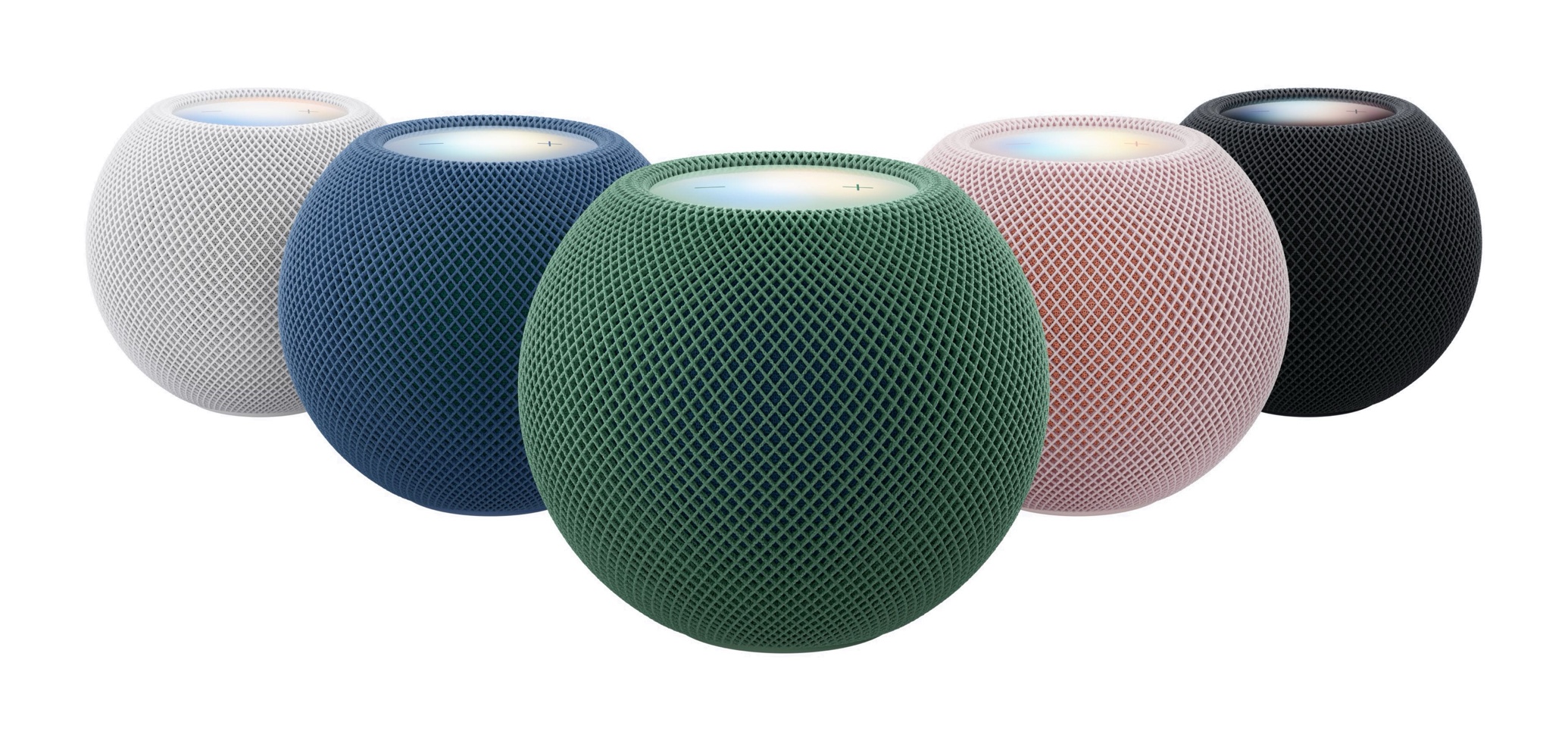
Among its smart home product announcements on Tuesday, Apple announced the new HomePod mini 2, priced at $149 and powered by an S10 chip (introduced in the Apple Watch Series 10). Curiously, its banner feature—support for Siri AI—will not be available when the product ships on October 30.
According to Apple, Siri AI will come to the HomePod mini 2 “in a future software update.” When it does, Apple’s press release hints that it will be able to tap into personal context when paired with an Apple Intelligence-capable iPhone or iPad. When there’s no such device available, it’ll still have access to broader Siri AI functionality, but won’t have access to the treasure trove of data that rides with your device.
Of course, since home accessories are the order of the day, Apple has touted the HomePod mini 2’s integration with the broader home experience. Like its predecessor, you can use it to control home devices via voice commands. Apple’s also supporting a new four-speaker surround sound setup, when four HomePod minis are connected to the new Apple TV 4K.
Apple also continues to tinker with that little glowing circle at the top of the HomePod, that’s not quite a display but is… something. The new Sound Glow feature turns it into a visualizer that is based on the sound of the currently playing song, and its color scheme will match the song’s associated album art.
By Dan Moren
Apple announces HomeView smart display
As was widely expected, Apple today took the wraps off its “HomePod with a screen”, dubbed the HomeView.
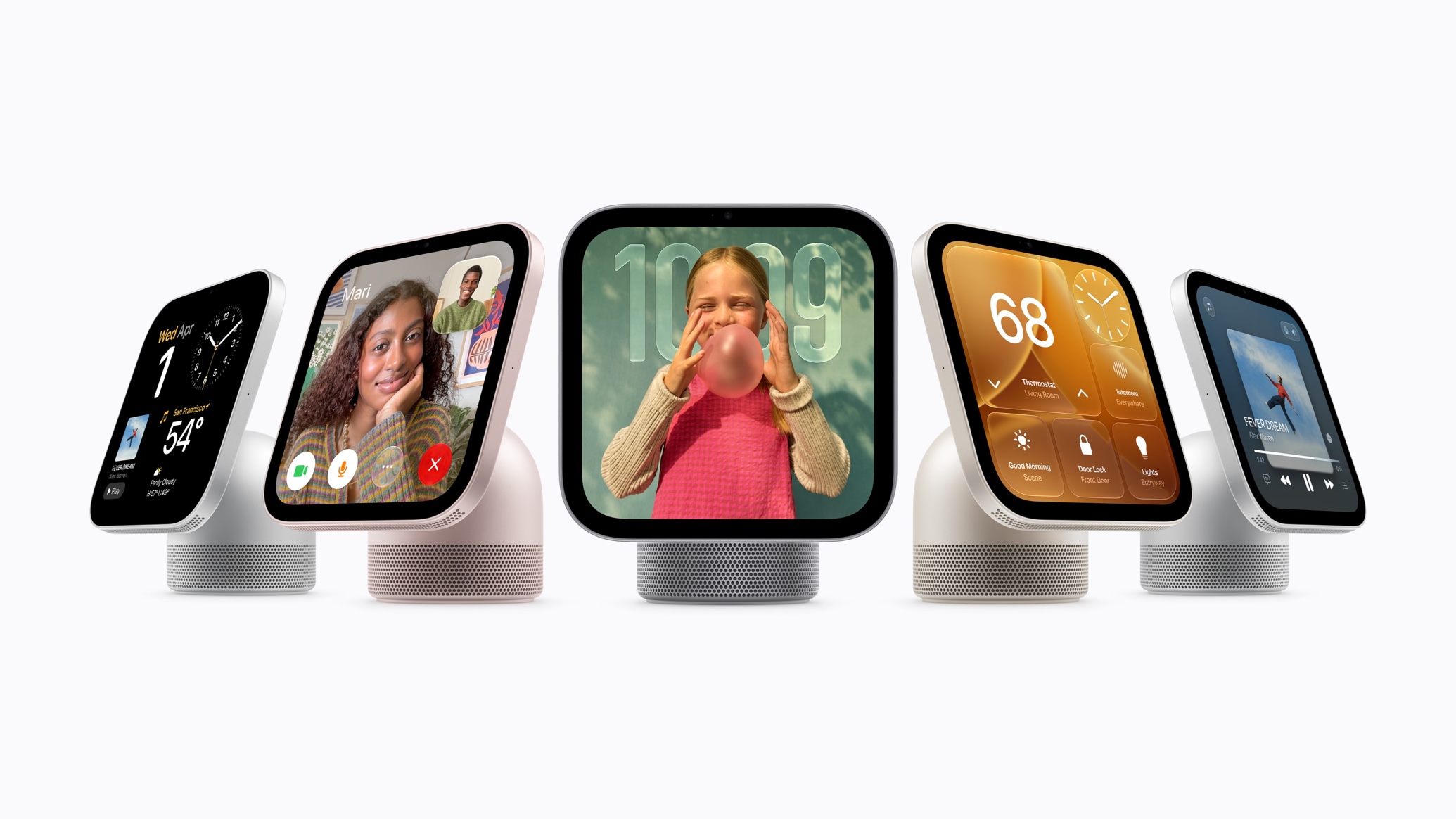
The device features a seven-inch Liquid Retina display with multitouch, at 1088-by-1088 resolution and is powered by an A18 chip. It comes in two different styles: a model intended to sit on a tabletop with a half-dome and small tilt-adjustable arm holding up the display, and one that’s meant to be wall-mounted. The former comes in silver, starlight, rose pink, and space gray options, while the latter has only silver and space gray.
The other main distinction between the two is the addition of more speakers on the tabletop version: a custom down-firing woofer and dual force-cancelling passive radiators. Both, however, nominally support spatial audio with Dolby Atmos. If you opt for the wall-mounted version, you can pick up a wall mount sold separately.
That A18 chip gives the HomeView enough juice to run Siri AI, which is at the heart of the new experience. The HomeView comes with a subset of built-in apps familiar from Apple’s devices, including Calendar, Home, Safari, Music, Messages, Podcasts, Weather, FaceTime, and more. Additional apps can be powered by a connected iPhone, including Apple News and Apple TV, as well as “supported third-party audio and video apps.” Apple says the device will recognize up to six people and gives them each their own home screen, while still allowing some shared features amongst all members of a household, such as music or shared photo albums. A 12MP Center Stage camera allows for FaceTime calls.
In terms of interface, the HomeView is reminiscent of the Apple Watch, with a customizable clock screen and various “faces”, including a Home Modular face that provides access to your commonly used smart home devices.
Apple also showed off a recipe specific mode that can detect recipes in Safari and format them appropriately for the device.
Both versions of the HomeView cost $299 and will be available on November 13. Pre-orders are open today for customers in Australia, Canada, India, New Zealand, the UK, and the U.S. The device is not available in the European Union, due to the lack of Siri AI in that region.
[Dan Moren is the East Coast Bureau Chief of Six Colors, as well as an author, podcaster, and two-time Jeopardy! champion. You can find him on Mastodon at @dmoren@zeppelin.flights or reach him by email at dan@sixcolors.com. His next novel, the sci-fi adventure Eternity's Tomb, will be released in November 2026.]
By Philip Michaels
App Report: Apps worth grabbing
It’s a real grab bag of apps in this week’s report, but that seems wholly appropriate somehow. After all, most of us turn to our Macs for a variety of reasons, so why not a selection of apps that speed up image processing, give you new controls over your tunes or help you keep a cleaner, better organized desktop? Oh, and there’s an iOS app in there, too, for the next time the travel bug bites you.
So why not reach in and see if any of the apps below grab you? And if there’s something we haven’t covered, drop us a line with the details at apps@sixcolors.com. We can’t respond individually, but rest assured that we take a look at every suggestion we get.
Freshly Squeezed
Each week I produce a weekly newsletter where I write about whatever’s on my mind — you should subscribe! — and one of the big production tasks is to take the images I’ve shot and convert them into 16:9 JPEGs cropped down to 2000 x 1125. It’s a job that would definitely benefit from batch processing, which is where an app like Freshly Squeezed comes into play.

Freshly Squeezed handles the jobs you’d expect from a batch image processor: It can resize, crop, compress and convert images to different files, all while retaining your originals. I’ve set up the app so that I can drop photos into it and get the right cropping and conversion, with Freshly Squeezed giving me the option to individually tweak crops if I want.
The app’s showcase feature is called Drop Folder, which you set up when you need to perform the same image processing over and over again. Once you’ve set up the parameters, just drop images into the folder, and Freshly Squeezed handles the rest.
You can download Freshly Squeezed onto your Mac for $7. A 7-day trial lets you try things out for free.
NepTunes

For another way to control music playback on your Mac, turn to NepTunes 4, which works with both Apple Music and Spotify. In fact, the Pro version of the app even lets you toggle between the two music services.
At its most basic, NepTunes lives in your menu bar, where it shows you whatever song is currently playing along with playback controls. You can also customize NepTunes to display additional info — I’ve got the app showing recently played songs, and if you link it to your Last.fm profile, you can see stats affiliated with that account. From the NepTunes interface, you can look up similar artists, while Pro users can find similar tracks to what’s playing. And all NepTunes users can set up hotkeys to control different playback features.
I keep mentioning the Pro version, which is a $10/year subscription. Besides the aforementioned features, Pro users can display their top albums in a grid. They can also download desktop widgets in various styles, such as one that displays the album you’re listening to like it’s a CD in a jewel case. You can peruse the 15 available widgets to get a flavor for NepTunes’ visual flair.
The Pro version comes with a 14-day free trial. Otherwise, NepTunes is a free download.
Tidy
It’s an occupational hazard that I have a lot of screenshots piled up around my Mac with names like Screenshot 2024-07-09 at 10.05.32 AM that tell me nothing about what’s actually contained in the screenshot. I imagine you might have the same problem with IMG files or PDFs or any file with an inscrutable collection of letters and numbers as its only means of identification.

Tidy is the answer to our organizational prayers. This $9 macOS download takes the screenshots, scans and other oddly named files from your Downloads folder, takes a look at them using its own built-in OCR feature and proposes readable names to help you better identify what the file actually contains. You approve the names, so nothing’s forced upon you, and Tidy only generates names using what it sees, so there are no hallucinations.
Even so, Tidy occasionally misses the mark. For example, a screenshot of the NepTunes app from up above got renamed “dutton-toster” because the font for singer Sutton Foster’s name proved too tricky to decipher. I was able to reject that suggestion, though, so no harm, no foul.
More often, Tidy proved to be on the money, as a photo of the ferris wheel looming over Disney’s California Adventure was retitled “blue-sky-land-amusement-park” — a much more decipherable moniker than IMG_435.HEIC.
Appricio

Appricio looks to be an indispensable travel companion by taking advantage of your iPhone’s location awareness. Fire up Appricio in a city included in one of the iOS app’s guides, and it can tell you what to do based on where you are, what the weather is and preferences shared in the settings.
You won’t just get a list of places to visit with Appricio, though. It’s a curated guide that makes specific suggestions, with a bias toward taking you off the beaten path (at least when you’re amenable to that). For example, Appricio detected that I’m near San Francisco and that the weather’s nice right now, so it steered me away from Pier 39 — which it dismissed as a tourist trap — and guided me to a day in Golden Gate Park instead.
Appricio would be a fine app if it just helped you in the moment, but it helps you plan trips, too. That feature is somewhat limited by the fact that the app only covers 50 cities at the moment, though I was able to do web searches for an upcoming visit to San Diego (currently not among the included cities) without the benefit of Appricio’s curation.
The app is free, though a $30/year subscription gives you a dozen more cities, a multi-day planning feature in which Appricio helps build your trip and an events calendar, among other bonuses.
Droppy

If you’ve looked at the notched display on your MacBook and thought, “I wish this worked more like the Dynamic Island on my iPhone,” Droppy is here to answer the call. At its most basic, this app lets you drag documents and files up toward the notch, where they can be stored for easy access until you find a more permanent home for them. But Droppy’s feature set doesn’t end there.
Droppy provides access to other features, like music playback controls, a clipboard that keeps the history of things you copy and paste and a five-hour weather forecast. Additional widgets — or Droplets, as the app dubs them — can be added to handle things like editing screenshots, file conversion, transcription and more.
While the app complements notch-equipped machines, it brings those Dynamic Island capabilities to other Macs as well. Droppy is free to try for three days; afterwards, a $10 payment unlocks the app for up to two Macs.
[Philip Michaels has been writing about technology since 1999, most notably for Macworld and Tom’s Guide. He currently finds himself between jobs, so if you need someone who can string a few sentences together (or make your sentences read a lot better), drop him a line.]
by Jason Snell
Apple’s new home hub is ‘HomeView’
Mark Gurman has last-minute Apple product details in his Sunday newsletter:
The centerpiece is a new smart home hub called the HomeView. Equipped with a display and an A18 chip, the product essentially serves as the Siri command center for an Apple-powered household…
The HomeView comes in two versions: a countertop model with a metal speaker base and a wall-mounted version with a flat, square base that sits against the wall beneath the display. The countertop offering will come in four colors: space gray, silver, starlight and pink, while the wall-mounted version will be limited to space gray and silver.
The name dovetails with a MacRumors report that Apple used a shell company to trademark “HomeView” last year. So much for my prediction of a re-use of the base HomePod name.
Gurman also says the new Apple TV remote will have a speaker, and the new Apple TV itself will have a microphone to enable it to receive Siri requests directly.
By Jason Snell
Is Apple coming home to stay?
The announcement that Apple’s making a home-related announcement on Tuesday was hardly unexpected. Most things Apple does these days are reported in advance, usually by Bloomberg’s Mark Gurman.
But this event has been years in the making. Gurman first reported in detail on the centerpiece product two years ago:
Apple… is nearing the launch of a new product category: a wall-mounted display that can control appliances, handle videoconferencing and use AI to navigate apps…. The company is gearing up to announce the device as early as March and will position it as a command center for the home, according to people with knowledge of the effort. The product, code-named J490, also will spotlight the new Apple Intelligence AI platform, said the people, who asked not to be identified because the work is confidential.
J490 did not, in fact, ship in March of 2025. The failed Apple Intelligence roll-out meant that the company had to push back the release of its AI-powered home products until after it could fix its AI issues and launch Siri AI last month.
It’s been a long time coming. Apple has made some runs at addressing the smart-home market in the past, but it’s never seemed to be part of a coherent, consistent strategy. (Many of us still can’t forgive it for abandoning the AirPort product line just as the advent of mesh networking would have provided the company opportunities that ended up accruing to companies like Eero, now a part of Amazon.)
Perhaps in new CEO John Ternus, Apple really does have a powerful internal advocate for the smart home. In a funny twist of fate, Apple’s intransigence in this category hasn’t really harmed its chances. Amazon and Google have been selling products similar to J490—touchscreen voice assistant home hubs—for years now, but they have failed to catch fire. I’ve used multiple Echo Shows and Google Nest Hubs in my kitchen over the years, and they have all been various degrees of terrible.
More broadly, the entire smart home market has suffered from fragmentation and mediocrity. Early devices were expensive, unreliable, and impractical. Things have gradually improved, and the tech giants have reached a detente that has made everything more interoperable. But even so, it’s really only this year that (for example) I feel like the smart lock has reached a level of tech capability that allows it to fulfill its promise, thanks to UWB support.
So is there a universe in which Apple rolls into this category at this late date and actually finds success where others have struggled to get traction? I’m not saying it’s a likely scenario, but it’s certainly possible. Apple’s track record with prioritizing user security and privacy is certainly an asset for anyone considering adding tech devices (especially ones with sensors) to their personal spaces. Apple’s tight device integration could also be a strong selling point for the many users who are fully bought in to the ecosystem.
So I’m saying there’s a chance.
The future of home is widgets?
The more I think about J490 or the HomePad or whatever it will ultimately be called—my money’s still on something with the HomePod name, possibly even just HomePod—the more I feel like it will expose Apple’s current thinking about the role of apps on its platforms. (Kind of an important topic.)
The wild success of the iOS App Store starting in 2009 transformed how Apple viewed the role of software in its operating system. Handed a big hammer, Apple saw nails everywhere. The Mac got an App Store, which exists, but I think nobody would consider a hit. The Apple Watch got an App Store, which also exists but seems kind of pointless. Messages got an App Store, which also exists, much to my surprise. And of course, tvOS was revamped under the premise that “the future of TV is apps,” but that future never really arrived.
Perhaps Apple has taken notice that the everything-has-an-App-Store strategy is really showing diminishing returns. The problem is, what do you do with a device like this forthcoming touchscreen? It doesn’t run iOS or tvOS, but apparently yet another variant of Apple’s omni-OS foundation. If it supports playing video from Apple TV but not Netflix, or podcasts from Apple Podcasts but not Overcast, or music from Apple Music but not Spotify, that’ll be frustrating. And the strength of the iPhone app ecosystem is one of Apple’s greatest assets.
So what’s Apple to do? My best guess is that it’s going to use some technology we’ve already seen to let your apps peek through on this new device from your iPhone. macOS Sequoia introduced the ability to display widgets and receive notifications directly from your iPhone—a feature that, given the timing, might actually have been invented for this as-yet-unreleased device!
In the long run, I wonder if the answer on devices that are ancillary to the iPhone—and I’ll throw the Apple Watch in here, too, since it already does this—is to allow app developers to include apps for alternate Apple platforms along with their existing App Store apps. You don’t actually need to use the watchOS App Store to download Apple Watch apps—you just get the iPhone app and your iPhone installs the app on your watch. If Apple wants real apps running on its smart home devices, perhaps they just transfer over from your iPhone.
In the meantime, projecting widgets doesn’t seem like a bad compromise to make the home hub more personal without requiring yet another App Store and all that complexity.
Of course, the next problem this product will face is that, as a device that sits in a home, it is probably going to need to interact with more than a single user. Beyond the Mac, Apple has struggled with the concept of multiple people using a single device. You can do it on Apple TV, but it’s not a great experience. You can do it, sort of, on HomePods. But if Apple is going to tie in the contents of a user’s iPhone with this home hub, it needs the device to be able to shift context on the fly and display content from a particular person’s iPhone, or (in the case of children or guests) someone without a paired iPhone at all.
Tricky stuff, and not a place where Apple has a great track record. Gurman’s reports suggest Apple is going to try a form of face recognition (that’s sub-Face ID level, but that’s probably okay for something found inside a home) in order to determine the context of which person is interacting with the device. We’ll see how it goes, and how responsive it can be if it’s got to connect to an iPhone and display widgets or load other personal data.
The Siri AI question
Then there’s the feature that has made these products all wait for their moment in the sun: Apple Intelligence. Apple has been slow to roll out iOS 27, probably to limit a surge of use of Siri AI on Apple’s servers. Numerous people have reported that Siri AI feels a little slower now than it did this summer, when the user base was smaller.
These products—not just the home hub, but next-generation HomePod mini speakers—will live or die with the functionality of Apple’s voice assistant. I’ve found Siri AI to be a pleasant surprise, an entirely functional voice assistant that replaced an entirely dysfunctional one. But if it fails me on my iPhone or iPad, I can just do things myself. That’s a lot less true on a device that’s meant to use voice as its primary interaction mode. Apple needs to get this right.
The rest of the story
Finally, there’s the question of how Apple will approach the entire smart home ecosystem. What product categories are worthy of Apple’s own brand name, and what ones can be served by preferred partners?
Gurman’s report this week that Apple is working with LG to build a smart lock and a series of security cameras, starts to answer that question. At least for now, it seems that Apple is going to approach this with three tiers: a few Apple-built products (home hub, speakers, TV box), some “second-party” products built in collaboration with Apple but released by LG and possibly others (cameras, lock), and presumably other Matter and Apple Home certified products that will receive Apple’s attention, promotion, and Apple Store placement.
I do wonder how Apple will make its decisions about what products it will decide to build itself. Will it go this far, but no further? Or do its LG collaborations give it time to figure out what categories could use a little bit of Apple magic? (Once again, I am imploring Apple to consider bringing back AirPort.)
That said, I’ve got a couple of Aqara 4K security cameras that work great, and the Aqara and Schlage UWB locks are pretty great. Apple doesn’t need to build products in new categories if other companies are making products that meet Apple’s standards. And maybe it’s hoping that its own moves here will set a direction and encourage further investment, so Apple doesn’t have to do everything itself.
After years of Apple never engaging with the smart home category for very long, this is an opportunity for a reset. What Apple announces on Tuesday will be a good start, but we’ve seen good starts from Apple before. It needs to keep its eye on the category, keep shipping new products, and continually improve its home software. If this is just a short-term lease, it’ll be pointless. Apple needs to get a mortgage and settle into its new home.
By John Moltz
This Week in Apple: Spooky season is upon us

AI does scary things, someone cut the phone lines, and Apple strikes twice.
The toddler that ate your hard drive
Are you tired of throwing your sabot into the machinery? Does it leave you shoeless and wondering if there isn’t a better way to fight the endless march into a dystopian future that leaves workers, artists, and writers jobless? Well, rejoice, comrade! Now you can fight back against the tide!
“Mac Users Reclaim 12GB+ of Storage With Apple Intelligence Removal Tool”
With the Apple models gone, you lose all Siri-related AI features, Writing Tools, Genmoji, Image Playground, ChatGPT integration, summaries, smart replies, inline predictions, Photos Clean Up, Spatial Photos, and Xcode predictive completion.
You had me at “Image Playground”.
That’s a joke, actually. If I delete Image Playground, how will Dan and I periodically terrify each other by texting the nightmare fuel of dead-eyed simulacra of ourselves it generates? Remember, Image Playground is supposed to be “fun”.…
This is a post limited to Six Colors members.
In this bonus episode, Jason interviews former Apple SVP of Retail Ron Johnson about why Steve Jobs wanted to get into retail, understanding what Apple’s brand represents, the customer-service model of the Apple Store, and much more.